Selling or buying real estate in French-speaking Switzerland is much more than a simple financial transaction. It is a complex process, marked by legal, tax, and administrative requirements. Faced with fluctuating mortgage rates and strict cantonal legislation, the guidance of a professional becomes a strategic asset to smoothly navigate this market. The real estate broker positions themselves as this indispensable orchestrator. They do not merely open doors during courtesy visits; they actively defend your interests, secure the entire transaction, and optimize the value of your built heritage. But faced with the multitude of players operating in the market, from the traditional agency to proptechs offering fixed flat rates, it is legitimate to wonder about the exact role of this professional. What is their true added value? What are their daily missions, from estimating the market value to the signing of the authentic deed? And above all, how is their remuneration justified in a system primarily based on success commissions? Decoding a profession located at the heart of the Swiss real estate ecosystem.
What is the exact role of a real estate broker in Switzerland?
The real estate broker acts as the privileged intermediary between sellers and buyers. In Switzerland, they evaluate the property at market price, orchestrate the marketing strategy, filter solvent buyers, and manage the legal steps until the signing of the notarial deed, thereby ensuring a secure transaction.
What is a real estate broker?
A real estate broker is an expert in the local market whose main mission is to facilitate the connection between supply and demand. Unlike some European countries, access to the profession is not protected by a mandatory federal diploma in Switzerland, although the latter exists and is a guarantee of excellence.
However, the reality on the ground requires a high level of expertise. A serious professional is generally affiliated with rigorous umbrella organizations such as USPI (Swiss Union of Real Estate Professionals) or SVIT. These bodies require compliance with a strict code of ethics and regular continuing education. The broker masters not only sales techniques but also the specificities of the code of obligations, the Lex Koller (LFAIE) for foreign buyers, and cantonal real estate capital gains taxes.
What does a real estate broker actually do?
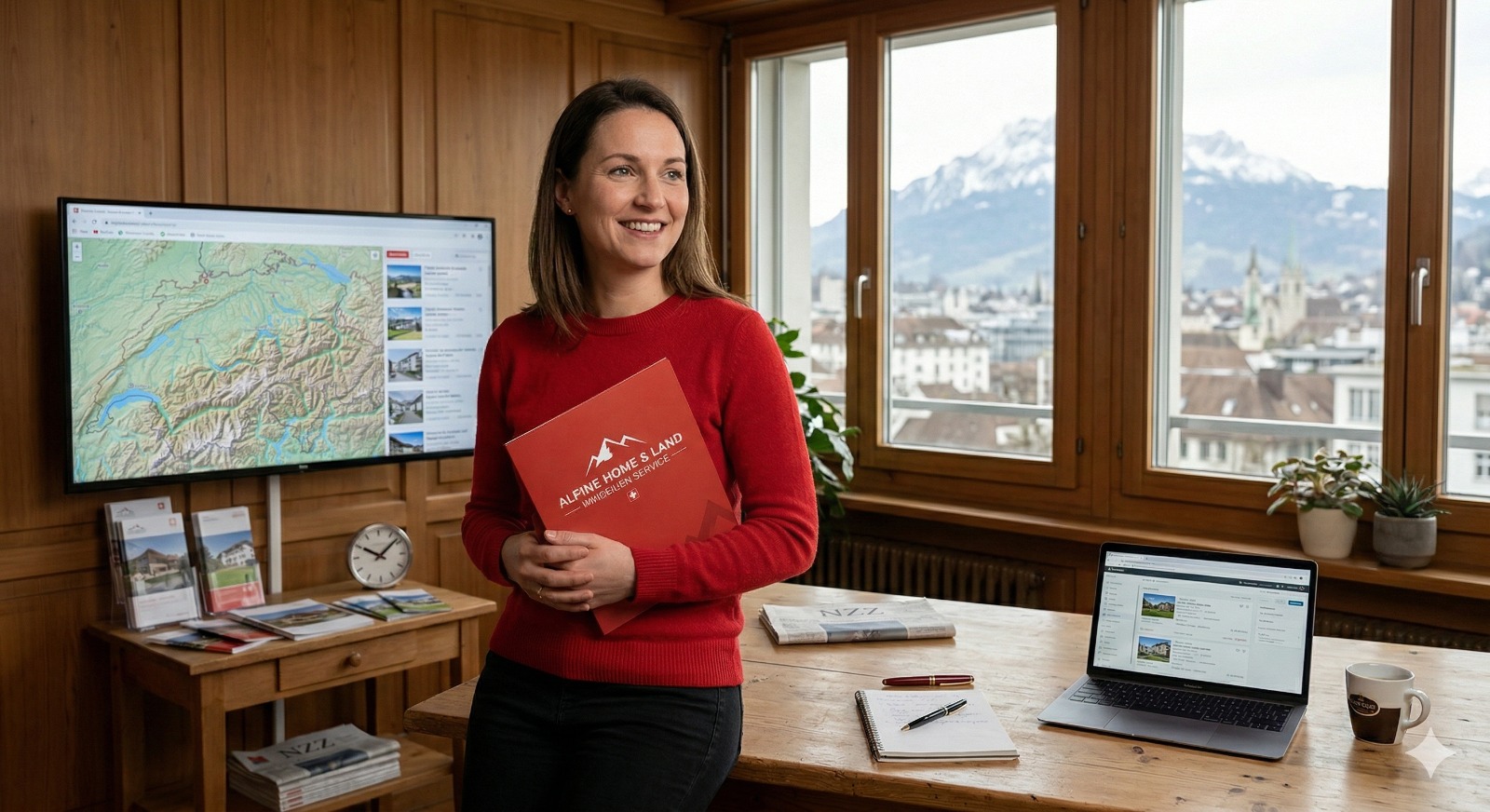
The work of the real estate intermediary encompasses a multitude of technical and commercial tasks, far removed from the clichés of the simple guided tour:
-
Precise real estate valuation: They determine the exact market value of the property using recognized methods (hedonic method, intrinsic or yield value). A correct evaluation prevents the property from "burning" on the market.
-
Building the legal file: They gather the Land Register extract, cadastral plans, the ECA insurance policy (particularly in Vaud), as well as the administration and use regulations (RAU) and minutes if it is a condominium ownership (PPE).
-
The marketing strategy: They create high-quality visual materials (professional photos, 360° virtual tours), write an exhaustive sales brochure, and target distribution on major portals or via their private "off-market" network.
-
Filtering and negotiation: They qualify potential buyers by requiring a preliminary bank financing certificate, then lead the negotiations to obtain the best possible deal.
-
Notarial support: They transmit the instructions to the civil law notary for drafting the draft deed of sale, explain the implications of property transfer taxes, and assist the parties until the handover of the keys.
How much does a real estate broker earn in Switzerland?
In French-speaking Switzerland, the broker's remuneration works almost exclusively on a "success fee" basis, meaning a commission on results. If the transaction is not completed, the seller generally does not pay any fees, although certain marketing costs may sometimes be invoiced depending on the signed brokerage mandate.
The commission rate is not fixed by law, but local customs provide a clear reference grid. This percentage, calculated on the final sale price, is generally degressive: the more expensive the property, the lower the percentage.
| Real estate property value (CHF) | Estimated average commission (%) |
|---|---|
| Up to 1,000,000 | 4% to 5% |
| From 1,000,000 to 2,000,000 | 3% to 4% |
| Above 2,000,000 | 2% to 3% |
| Proptech agencies (flat rate) | Fixed price (e.g., 12,000 CHF) |
It should be specified that the salaried broker of a large agency only receives a fraction of this commission (often between 10% and 20%), with the rest covering the company's fixed costs. The independent broker, on the other hand, receives the entire amount but assumes all social security, insurance, and advertising costs.
How to choose the right real estate broker?
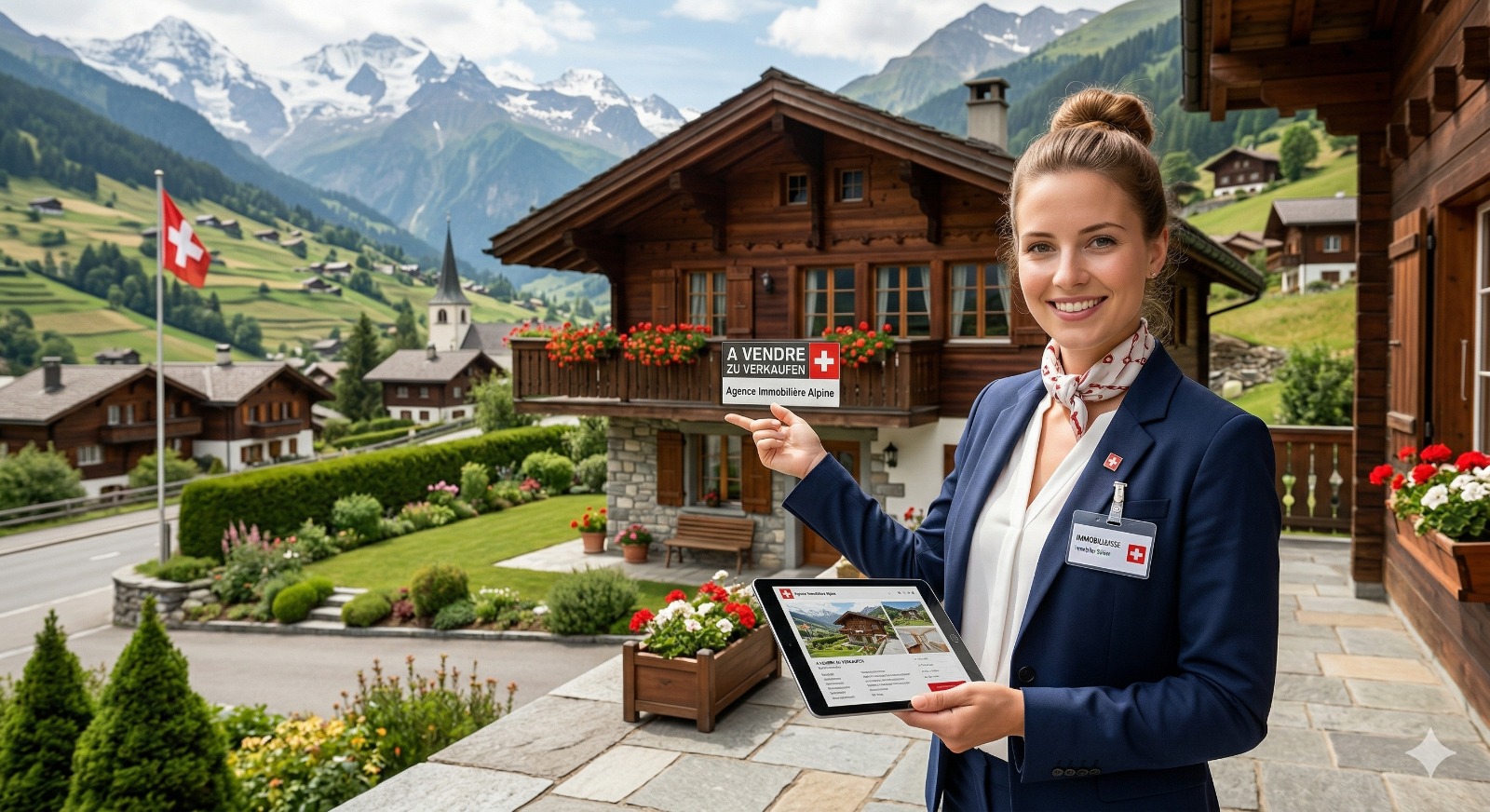
Entrusting your assets requires an absolute level of trust. To select the ideal partner, several objective criteria must be validated from the very first meeting.
First, check their local roots: a broker who knows the municipality has a network of active buyers and masters the specificities of the general allocation plan (PGA) of your region. Then make sure of their affiliation with a professional organization like USPI, ensuring ethical follow-up. Ask them to explain their estimation method with full transparency; avoid those who artificially inflate the price to get the mandate. Finally, the quality of their listening skills and the clarity of their marketing plan will be the best indicators of their future investment in your sales project.
How to become a real estate broker in Switzerland?
Although the profession is not strictly regulated by an obligation of specific studies to start, professional training has become crucial to survive and excel in this highly competitive sector.
Here are the key steps and tips to successfully launch in the Swiss market:
-
Basic training: A CFC (Federal Certificate of Capacity) as a commercial employee, ideally completed within a real estate agency or property management firm, provides an excellent entry point to understand the administrative workings.
-
Professional certifications: Following the basic modules offered by institutions like USPI or SVIT (for example, the real estate assistant certificate) allows you to quickly acquire technical, commercial, and legal fundamentals.
-
The Federal Diploma: This is the Holy Grail of the profession. Obtaining the "Federal Diploma for Real Estate Brokers" attests to superior expertise recognized by the Confederation. It opens doors to high-responsibility positions or greatly facilitates setting up as an independent.
-
Developing soft skills: Beyond diplomas, an excellent broker must cultivate their relational network (notaries, bankers, craftsmen), show great resilience in the face of failures, and possess natural empathy to understand the emotional stakes of their clients during a transaction.